The printing industry is undergoing a rapid transformation that replaces its existing manual operations with automated digital systems. Trade printers across the US often struggle with order errors, complex pricing, and the efficient management of reseller relationships. These challenges impede business expansion while decreasing profit margins.
This is where web-to-print automation becomes critical, not as a tool, but as a system that restructures how your print business operates. Let us dive into the blog to know web-to-print solutions for trade printers.
Why Manual Trade Printing Workflows Fail at Scale
Manual printing processes in the trade printing sector often become nonadaptive as organizations expand their operations. Manual printing processes involve a higher chance of errors during order entry, resulting in wrong quantities or format. Moreover, pricing issues such as inconsistencies are likely because manual calculation of costs is involved.
There are usually production delays, which occur as a result of back-and-forth communication with customers on file edits and approvals. Dealing with several resellers makes things harder, since managing orders and communicating becomes difficult.
For instance, a trade printer situated in the United States dealing with bulk printing of marketing materials for an organization in preparation for its nationwide retail promotion might be operating under strict deadlines.
What Is a Web to Print Solution and How Does It Transform Trade Printing?
A web-to-print solution is a web-based software application that facilitates the order fulfillment process for print businesses through its print order management system. Rather than relying on manual processes, the software allows customers to submit job orders via an online print ordering system interface while performing various automation tasks on the back end.
Some important features of such systems include price engines, order tracking, and automated file processing. In trade printing, Web to Print streamlines all processes for greater efficiency.
Actual Business Benefits of Web-to-Print for Trade Printers
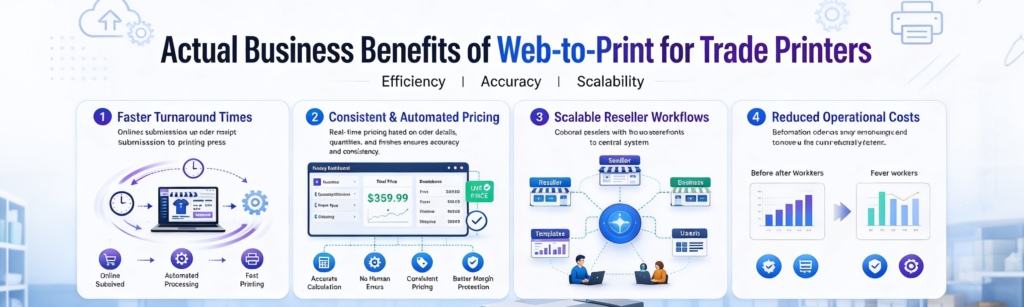
Here are the most impactful ways web-to-print improves efficiency, accuracy, and scalability for trade printers:
- Faster Turnaround Times: Automation facilitates the receipt and processing of orders. With a unified online platform, the order turnaround time from receipt to printing will be significantly reduced using print automation software.
- Consistent and Automated Pricing: An automated quote engine provides real-time pricing based on parameters such as order details, quantities ordered, and finishes. This will prevent human errors and guarantee consistent pricing for all orders.
- Scalable Reseller Workflows: Through a web-to-print solution, businesses can on-board resellers with their individual storefronts and templates.
- Reduced Operational Costs: Fewer hands are needed to complete certain processes manually, reducing the need for labor and communication overhead and thereby decreasing operational costs through automated printing software.
Together, these benefits enable trade printers to streamline operations, protect margins, and scale their business with greater confidence and control.
Who Benefits Most from Web-to-Print Automation?
Web-to-print automation delivers the most value to print businesses dealing with high order volumes, complex pricing, and multi-client workflows. While almost any print company can benefit, the impact is especially significant for the following segments:
1. High-Volume Trade Printers
Print businesses handling 50–100+ orders per day often face operational bottlenecks as they grow.
Common challenges :
- Manual order entry slowing down processing.
- Frequent file errors (incorrect size, low resolution, missing bleed).
- Production delays due to incomplete job details.
How web-to-print helps :
- Automates ordering process through structured online forms.
- Performs instant file validation before production.
- Reduces manual touchpoints across the workflow.
Result : Faster order processing without needing to continuously expand your team.
2. Trade Printers Working with Resellers
For printers managing multiple resellers, complexity increases significantly due to custom pricing, branding, and order variations.
Common challenges :
- Handling different pricing structures for each reseller.
- Managing orders via emails, calls, or spreadsheets.
- Maintaining brand consistency across multiple clients.
How web-to-print helps :
- Provides dedicated storefronts for each reseller.
- Applies predefined pricing rules automatically.
- Enables template-based ordering for consistent output.
- Automates proofing and approvals.
Result : Streamlined reseller management with fewer errors and faster turnaround.
3. Multi-Location Print Businesses
Print companies operating across multiple locations often struggle with inconsistent processes and lack of standardization.
Common challenges :
- Different pricing or product configurations across branches.
- Inconsistent file handling and production workflows.
- Difficulty maintaining brand and quality standards.
How web-to-print helps :
- Centralizes ordering and workflow management.
- Standardizes templates, pricing, and product options.
- Ensures uniform production processes across locations.
Result : Consistent output and operations, regardless of location.
4. Growing Print Businesses Looking to Scale Efficiently

Businesses in a growth phase often reach a point where manual systems can’t keep up with demand.
Common challenges :
- Increasing workload without scalable systems.
- Rising dependency on manual coordination.
- Difficulty maintaining margins as complexity grows.
How web-to-print helps :
- Automates repetitive tasks like pricing, proofing, and job routing.
- Reduces dependency on manual intervention.
- Supports business expansion without a proportional increase in staffing.
Result : Scalable growth with better control over costs and operations.
Key Takeaway
Web-to-print automation is most impactful when operational complexity increases whether through higher order volumes, reseller networks, or multi-location setups. It allows print businesses to move from manual coordination to structured, system-driven workflows, enabling more efficient and predictable growth.
Outcome : A streamlined, predictable workflow that reduces operational friction while enabling scalable growth.
| Stage | Process Overview | Operational Value |
|---|---|---|
| Order Intake | Orders are submitted through structured online storefronts with predefined product configurations and templates. | Reduces order ambiguity and eliminates manual data entry. |
| Pricing Automation | Rule-based pricing engines calculate costs in real time based on specifications, quantities, and predefined margins. | Ensures pricing consistency while protecting profitability. |
| File Preflight & Proofing | Automated validation checks for resolution, dimensions, bleed, and format, with instant digital proof generation. | Minimizes production errors and reduces rework. |
| Production Workflow Integration | Approved jobs are automatically routed to production systems with complete, standardized job specifications. | Improves workflow efficiency and accelerates job turnaround. |
| Fulfillment & Tracking | Integrated shipping and tracking systems provide real-time status updates to customers and resellers. | Enhances transparency and overall customer experience. |
Tips for Implementing Print Automation Successfully
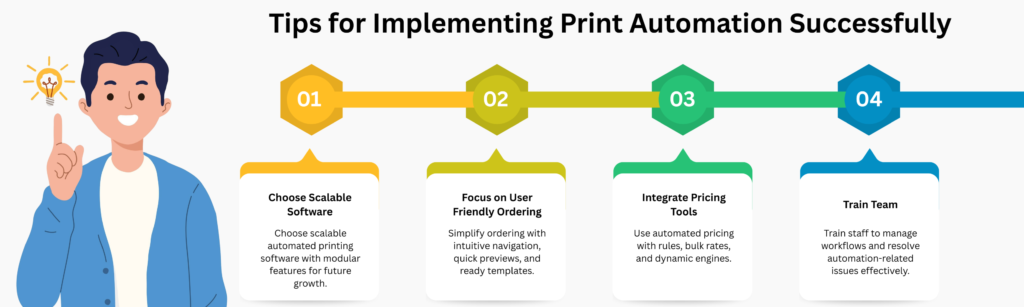
Implementing print automation successfully requires a strategic approach that aligns technology, workflows, and user experience with your business operations.
- Choose Scalable Software : Begin by selecting software that will allow you to grow as you scale. Consider automated printing software with modular functions you can easily add as you expand into more products, users, or geographic locations.
- Focus on User-Friendly Ordering : Make ordering as simple as possible for resellers. Automated printing software makes it easier for resellers to navigate the site and provides quick previews and template options.
- Integrate Pricing Tools : Utilize software that automatically generates price calculations based on rules, bulk pricing, and dynamic pricing engines. This will ensure consistency in prices, timely quotations, and margins.
- Train Team : Train your employees to use the software so they can handle different workflows and problems arising from automation.
When executed correctly, these practices ensure a smoother transition to automation, enabling more efficient operations and long-term scalable growth.
Conclusion
Web-to-print automation is no longer optional for trade printers managing growing order volumes and reseller complexity. By streamlining order intake, pricing, file validation, and production workflows, it reduces errors, improves turnaround times, and protects margins. More importantly, it enables scalable operations without increasing manual workload, helping print businesses build a more efficient, predictable, and growth-ready workflow.
Frequently Asked Questions
What Is The Best Web To Print Solution For Trade Printers?
The best solution combines web-to-print with MIS/ERP capabilities, enabling end-to-end automation from order capture to production and invoicing. Scalable platforms support multiple storefronts while providing automated processes and real-time reporting, which enables trade printers to manage increasing production demands with greater efficiency.
How Does A Print Order Management System Improve Efficiency?
The print order management system uses automation to handle three main tasks which include order entry, job ticketing and workflow routing. The system decreases operational manual work while improving delivery times. Automated processes in the system reduce human errors that occur during pricing and production and approval processes.
What Features Should A Print Ordering System Include?
The system provides automated pricing engines, workflow and job management features, CRM integration, and inventory tracking and reporting dashboards as its key capabilities. The system requires both strong API integrations and proofing tools to enable smooth operational processes.
Is Web To Print Software Suitable For Small Trade Printers In The USA?
Yes, modern web-to-print solutions are scalable and modular, which enables small printers to begin their operations with essential functions while they develop their business needs. The platforms have been built to accommodate the requirements of both small businesses and large corporate operations.
How Much Does Web To Print Software Cost In The USA?
Costs typically range from around $500/month for starter plans to $1,000+/month for advanced solutions, with enterprise pricing custom-based. The pricing model uses user count, integration needs, storefront requirements and automation complexity to determine final costs.
Can Web To Print Software Integrate With Existing Print Workflows?
The majority of solutions provide API-based connections to MIS, CRM, accounting, and shipping systems. This system enables uninterrupted data movement throughout current printing operations by preventing data duplication.
How Secure Are Online Ordering Systems For Printing Businesses?
Companies employ secure payment gateways together with encrypted data protection systems and role-based access control mechanisms to safeguard their customer information and business data. Cloud platforms maintain both their security standards and data protection requirements through continuous backup processes.
What Industries Benefit Most From Print Automation Software?
Print automation is especially useful for Wholesale Trade Printer managing high order volumes, as it helps reduce manual work and speed up production. It also benefits Wholesale Printing for Resellers who need streamlined ordering and consistent branding through dedicated storefronts. Additionally, B2B Printers gain from standardized ordering processes, making procurement faster, more accurate, and easier to manage.
Simplify Your Trade Printing Workflow Today
Explore how web-to-print can automate orders, pricing, and reseller workflows for more efficient, scalable operations.