Key Takeaways
- Scaling challenges are operational, not just demand-driven : Manual workflows, pricing inconsistencies, and approval delays often limit growth in print businesses.
- Online printing software is ideal for getting started : It works best for standardized products, simple workflows, and quick setup with minimal technical effort.
- Web-to-print services support long-term scalability : They offer customization, automation, and deep integrations for handling complex workflows and high order volumes.
- The right choice depends on your business stage : Small print shops benefit from simplicity, while growing businesses need flexibility and system control.
- Automation is critical for efficiency : It reduces errors, speeds up turnaround, and improves overall workflow management.
Choosing the right approach is less about features and more about aligning technology with your operational complexity and growth goals.
Introduction
Scaling a print business today is not easy due to increased order volume, tighter deadlines, inconsistent pricing, and higher customer demand. This means that traditional methods are no longer effective. As such, it is no wonder that most printing companies are increasingly automating their processes to remain relevant.
However, the main issue is whether to choose fully managed web-to-print services or online printing software. Let us dive into the blog to learn more about web-to-print services vs. online printing software.
Why Most Printing Businesses Struggle to Scale Smoothly

Many print firms reach a certain level beyond which they cannot grow, not for lack of market demand, but due to system inefficiencies. The manual system for processing orders, making design changes, and pricing is time-consuming and causes delays.
Online solutions may not be flexible enough for customized work and may be unable to accommodate different clients. Pricing mistakes and variations in the order specifications result in low profit margins.
For instance, a small- to medium-sized printing company that handles large orders for corporate events will definitely find manual management difficult. High-volume orders are quite challenging without efficient processes in place.
Understanding Web-to-Print Services and Online Printing Software
Before making a decision, it’s important to look beyond features and understand how each model actually works in a real print business environment—especially when dealing with order complexity, client expectations, and day-to-day operations.
What Are Web-to-Print Services?
The web-to-print services are made specifically for print companies that no longer need generalized software tools but require solutions customized according to their workflow from customer ordering to job manufacturing.
Custom web-to-print solutions can seamlessly integrate with MIS and ERP systems by enabling more effective cross-system communication and making the entire process more visible.
For example, if a print company has numerous clients and order volumes are rather high, then integration will be especially important. The flexible structure of such services makes them better suited to large print companies than to generalized tools when adopting the best web-to-print software for long-term scalability.
What is Online Printing Software?
Online printing software comprises digital systems that enable printing firms to receive, organize, and fulfill their orders online as quickly as possible. Online printing software packages offer built-in templates, storefronts, and automated features, making them ideal for companies looking to establish themselves quickly with minimal programming effort.
Online printing software solutions are convenient for managing the file upload process, price calculations, and order tracking. Thus, online printing software suits only those print businesses whose products are straightforward and whose costs are clearly stated.
Web-to-Print System vs Online Printing Software : Key Differences
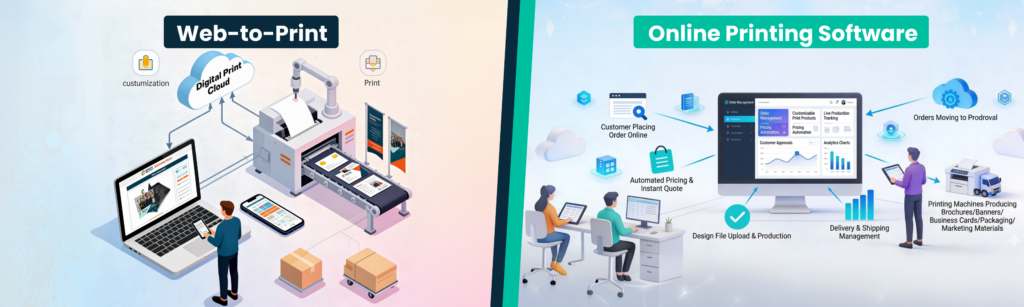
Here’s a practical comparison of web-to-print services and online printing software, based on key factors like workflow control, scalability, integrations, and pricing that directly impact your print business operations and long-term growth.
Operational Comparison : Which Model Supports Scalable Print Workflows?
| Factor | Web-to-Print Services | Online Printing Software |
|---|---|---|
| Customization | Fully tailored workflows, pricing logic, B2B portals, and product configurations aligned to business operations | Template-based setup with limited flexibility for non-standard jobs |
| Scalability | Built for high-volume environments, multi-storefronts, and complex order handling | Suitable for small catalogs; scaling often requires workarounds |
| Pricing Structure | Higher upfront or project-based cost, optimized for long-term operational efficiency | Lower entry cost (SaaS/subscription), but costs and inefficiencies grow with scale |
| Integration Flexibility | Deep integration with MIS, ERP, CRM, accounting, and fulfillment systems | Basic or limited integrations; may require manual data handling |
| Ease of Use | Requires onboarding but enables structured, error-free operations | Quick to launch, easy for small teams with simple workflows |
Ultimately, the right choice depends on whether your priority is quick setup for simple workflows or building a system that can handle complexity and scale without operational bottlenecks.
Which Option is Right for Your Print Business?
The choice between the two options is dependent on the size of your print business and your growth plans. Online printing software is the optimal solution for small printing companies.
The web-to-print software solutions provide businesses with inexpensive services that they can implement without delay because they offer complete functionality that includes ordering systems, simple customization, and workflow control.
If your print shop expands, then a hybrid solution would work well for you, allowing you to automate your processes using software and web-to-print services.
How Automation Streamlines and Improves Print Workflow Efficiency

Advanced technology becomes efficient, leading to an increase in print production, reducing the intrusion of human intervention in the various operations of production.
The printing industry uses print automation software to manage customer orders, create real-time cost estimates, and handle order approval.
The system allows customers to place orders, which move to production while the pricing system verifies correctness and the automatic approval process removes delays.
The printing business achieves improved efficiency through quicker service delivery, reduced mistakes and better control of its daily operations that enable it to expand its operations while providing stable service and high customer satisfaction.
How to Choose the Right Print Solution for Long-Term Growth
Choosing the right solution isn’t just about features; it’s about how well the system aligns with your current workflows and future growth plans.
| Factor | What to Evaluate | Why It Matters |
|---|---|---|
| Scalability | Ability to handle high order volumes, multiple storefronts, and expanding product catalogs | Prevents system limitations as your business grows |
| Customization | Support for client-specific workflows, pricing rules, branding, and product configurations | Ensures flexibility for complex and B2B print requirements |
| Long-Term ROI | Impact on manual workload, error reduction, and operational efficiency, not just upfront cost | Determines real cost savings and profitability over time |
| Integration Capabilities | Compatibility with MIS, ERP, CRM, payment gateways, and shipping systems | Enables seamless data flow and reduces manual intervention |
| Workflow Automation | Features like automated approvals, preflight checks, and job routing | Improves turnaround time and minimizes costly errors |
The right choice should not only solve current challenges but also support your business as order complexity and customer expectations continue to evolve.
Conclusion
Growing print businesses often choose between speed and scalability. Online printing software helps you get started quickly and manage simple tasks. Web-to-print solutions, however, support automation and long-term growth. As your business becomes more complex, basic tools may no longer be enough, making a more flexible and scalable system the better choice.
Frequently Asked Questions
What Is The Difference Between Web-To-Print Services And Online Printing Software?
Web-to-print services deliver complete automation that combines product display through shopfronts with customer design options and their subsequent purchase processes. The online printing software serves as a fundamental tool that enables users to submit and manage their print requests.
Which Is Better For Scaling A Print Business in The USA?
The automated Web-to-print solutions enable businesses to expand their operations by combining centralized control across multiple business locations with automated processes. The system enables organizations to handle higher-order volumes because it decreases the need for manual work.
How Much Do Web-To-Print Services Cost in The USA?
The price range for services starts at $50 per month for basic plans and extends to over $5000 for customized enterprise solutions. The pricing structure relies on the specific features, available integrations, and the size of the organization.
Can Online Printing Software Handle Complex Print Workflows?
The standard online printing software experience has difficulty handling advanced workflows that require both variable data printing and multi-step approval processes. The advanced tools provide some automation capabilities, but their automation features cannot fully adapt to different business requirements.
When Should I Switch From Printing Software To a Custom Web-To-Print Solution?
When order volume increases and manual processes cause operational delays and your business needs both automation and system integrations, then the system should switch operationally. The company needs to scale its operations because its business requires efficient processes that centralized management can provide.
What Features Should The Best Web To Print Software Include?
The system is capable of providing necessary functionalities through personalized online shops, developing pricing structures, performing automated operations, and integrating with the management information and ERP systems. The system requires a solution that can provide verification process capabilities in addition to order monitoring.
Are Web-To-Print Services Worth It for Growing Print Businesses?
The system enhances operational efficiency, reduces error rates, and simplifies the process of managing orders. The system provides long-term advantages by reducing operational expenses and increasing business profitability.
Can Web-To-Print Solutions Integrate With MIS, CRM, or ERP Systems?
Modern web-to-print solutions establish complete compatibility with MIS systems, CRM systems and ERP systems. The system creates better data transfer, which results in automated processes that improve overall business operations.
Scale Your Print Workflow with the Right System
Explore how a tailored web-to-print solution can simplify workflows, reduce errors, and support your business as it grows.